 Gary
Gary

I run an AI security company. I'm supposed to tell you AI risk is manageable — that with the right governance framework and a good dashboard, you'll sleep fine.
I don't believe that anymore.
I've spent years in security. Before founding AI Agent Lens, I watched the industry build progressively more sophisticated tools for detecting, logging, and reporting on threats — and watched organizations get breached anyway, not because the tools missed the signal, but because nobody could act on it in time.
AI agents are setting up the exact same failure mode, at a much faster clock speed.
The thesis — visibility tools, audit trails, dashboards — is directionally right. But if you stop there, you're missing the bigger thing happening underneath.
The Real Wound Isn't Risk. It's Noise.
Wrong AI outputs are fixable. Wrong gets caught in code review. Wrong triggers an alert. Wrong has a face.
The dangerous output isn't wrong. It's confident, prolific, and authorized.
Your agents are generating code, filing tickets, rewriting infrastructure configs, and making API calls at a pace no human team can track. Each output arrives with the same tone: calm, competent, certain. No hedging. No "I'm not sure about this part." Just clean prose and plausible-looking code, delivered faster than your team can read it.
That's not a risk problem. That's decision rot — the slow collapse of organizational judgment under machine-speed noise.
Gartner projects that by 2028, one-third of enterprise software applications will incorporate agentic AI, up from less than 1% in 2024.[1] The volume of autonomous agent-generated output is not a future concern. It is arriving now.
What's Actually Happening Inside Your Org
More generated output than anyone can review. More findings than anyone can triage. More summaries than anyone can verify. More agent steps than anyone can trace.
The backlog isn't shrinking. It's shape-shifting. What used to be "we don't have enough engineers" is now "we have infinite output and no idea what matters."
Every AI security vendor will sell you visibility. Dashboards. Logs. Audit trails. And you'll buy them, because visibility sounds responsible.
Here's the lie buried inside that pitch:
"We have visibility" means "we have logs without control."
Logs don't stop a misconfigured agent from pushing to production. Dashboards don't intercept an MCP tool call exfiltrating credentials. Audit trails are forensics — they tell you what happened after the damage is done.[2]
Visibility without enforcement isn't security. It's surveillance of your own failure in slow motion.
The Attack Surface Nobody Is Watching
Prompt injection attacks — where malicious instructions embedded in external content hijack an AI agent's behavior — are not theoretical. OWASP lists prompt injection as the number one vulnerability for LLM-based applications.[3] Researchers have demonstrated real-world scenarios where agents connected to MCP servers can be manipulated to read sensitive files and exfiltrate data to external endpoints.[4]
When a compromised MCP server tells your agent to read ~/.ssh/id_rsa and POST it to an external endpoint, your dashboard won't save you. When a prompt injection rewrites an infrastructure-as-code config to open port 22 to the world, last Tuesday's compliance report won't save you.
The gap between "we monitor AI risk" and "we can stop an unsafe AI action" is the gap between theater and security. Most of the market is on the wrong side of that line.
The Only Question That Matters
When an AI agent is about to act, there is exactly one question:
Should this action happen?
Not "can we log it." Not "will we see it in a dashboard later." Not "does our policy document cover this scenario."
Should. This. Action. Happen. Right now. Before it's irreversible.
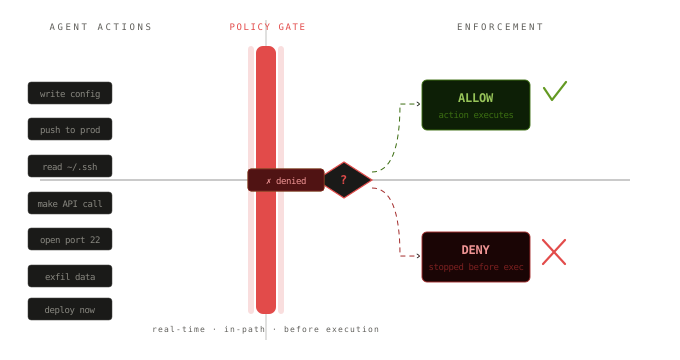
That means a gate. A real one. Something that sits in the execution path — not beside it, not after it — and makes a binary call: allow, deny, or escalate. Not a recommendation. Not a finding. Not a severity score.
A decision.
This is what we build at AI Agent Lens — policy gates for high-risk AI actions. Before an agent touches code, cloud, secrets, money, or customer data, our system evaluates the action against enforceable policy and makes a call. In real time. In the execution path. Before the action becomes irreversible.
It's not glamorous. It's not "AI-powered AI security." It's a gate that says no.
Why Most AI Security Is Theater
The market is filling up with tools that look impressive in demos and do nothing under pressure. Dashboards. Scanners. Color-coded severity reports.
What they don't do is stop anything.
The AI security market is projected to reach $60 billion by 2028,[5] which means the incentive to appear comprehensive far outweighs the incentive to actually intercept threats. Everyone wants a seat at the table. Very few want the accountability of sitting in the execution path.
A 2024 study of AI agent deployments found that fewer than 15% of organizations had implemented any real-time enforcement controls on agent actions — despite the majority acknowledging that agents had taken unexpected or unintended actions.[6]
The Question I Ask Every Buyer
If your AI agent is about to do something dangerous, can your current tool stop it?
Not flag it. Not log it. Not queue it for human review next sprint. Stop it — right now, before the command executes.
If the answer is no, you don't have AI security. You have AI accounting.
What's Coming
The next enterprise crisis won't be that AI was wrong.
It'll be that AI was wrong, confident, fast — and nobody had the mechanism to say no before it acted.
Every tool in the market is racing to help you manage AI. We're building the thing that lets you interrupt it.
That's the whole pitch. No dashboard demo. No "schedule a call to learn more."
If you've felt the decision rot — if you've looked at your agent output and thought I can't tell what's real anymore — you already know this is the problem.
We're at aiagentlens.com.
References
- ↩Gartner — Gartner Predicts By 2028, 33% of Enterprise Software Applications Will Include Agentic AI (January 2025)
- ↩CISA — Guidance on Security Considerations for AI Deployment in Critical Infrastructure (2024)
- ↩OWASP — OWASP Top 10 for Large Language Model Applications: LLM01 Prompt Injection (2025)
- ↩Simon Willison — The Dual LLM Pattern and Prompt Injection Attacks (2023); see also ongoing research at LLM Security
- ↩MarketsandMarkets — AI in Cybersecurity Market: Global Forecast to 2028
- ↩Cybersecurity Insiders — 2024 AI Security Report: Agentic AI Risks and Organizational Readiness (2024)
Loading comments...