 Anshuman Biswas
We’ve all watched SaaS valuations take a beating over the past few months. Lately, it feels like every time Claude rolls out a new feature, SaaS stocks drop another few percentage points. But here’s how I interpret what’s actually going on.
I spent the better part of two decades in software — as an engineer, as a manager, as a VP, and somewhere in between all of that, as someone who's watched more startup funding cycles than I care to count. I've been at venture-backed companies when the money was flowing and when it wasn't. I've lived through acquisitions on both sides of the table. I've had the conversation with founders who were absolutely certain their SaaS ARR made them untouchable to market cycles.
The thesis — less liquidity, less VC money, less startup funding, smaller SaaS job market — is directionally right. But if you stop there, you're missing the bigger thing happening underneath.
The Chain Is Real, But It's Not the Point
Let me walk through the mechanics quickly, because they matter.
When exit markets dry up — fewer IPOs, fewer acquisitions, fewer distributions back to LPs — the whole venture flywheel slows down. LPs don't get cash back, so they commit less to new funds. VCs raise less, or take longer to raise. MSCI noted in May 2025 that private-capital distributions remained subdued, and that LPs hoping for a liquidity burst should brace for another dry year[1]. By H1 2025, U.S. VC fundraising had fallen to its lowest fund count in a decade[2], with median time to close a fund stretching to 15.3 months. That's not a blip. That's structural.
But here's the thing that confused a lot of people: headline startup funding actually went up in 2025. KPMG reported U.S. VC investment hit $339 billion for the full year — a four-year high[4]. Globally it crossed $500 billion[5]. How is that possible when fundraising was grinding?
Because the money didn't spread. It concentrated.
Five companies — OpenAI, Anthropic, Scale AI, xAI, and Project Prometheus — raised $84 billion between them. That's 20% of all venture dollars tracked by Crunchbase in a single year, in five companies.
AI/ML deals absorbed 64.3% of capital by Q3[3]. If you were a typical B2B SaaS startup going out for a Series A in 2025, you weren't competing for that money. You weren't even in the same conversation.
So yes, the chain is real. Less liquidity, tighter fundraising, harsher conditions for most startups, a leaner hiring environment. Carta's data showed startup new hires in January 2025 were down 62% from the January 2022 peak[9]. Sixty-two percent. That's not a soft landing. That's a different world.
But here's what I keep coming back to. The funding environment is the weather. The AI disruption to SaaS is the climate.
What I've Actually Watched Happen to the Moat
I've sold software to enterprises. I've been in rooms where procurement teams spent months evaluating vendors, where contracts had three-year lock-ins, where the switching cost was so real it was almost physical. That stickiness — that was the SaaS moat. That was why private investors loved enterprise SaaS. Predictable ARR, high retention, expansion built in. You didn't have to explain the model. The model explained itself.
That model assumed something: it assumed software was hard to build.
If I wanted to compete with an established SaaS vendor in, say, contract management or expense tracking or even a mid-complexity security workflow tool, I needed a team, runway, time, and luck. The incumbent had years of accumulated feature work, a customer success team that had embedded itself into the customer's operations, and integrations everywhere. The barrier wasn't just the product. It was the compounded effort of building it.
That compounded effort is now dramatically cheaper to replicate.
I've watched this with my own hands this year. With the current generation of coding agents, a reasonably experienced engineer can prototype something that would have taken a small team six months — in days. Not a toy. Something that actually runs, actually handles edge cases, actually has test coverage. The specification is the hardest part now, not the implementation.
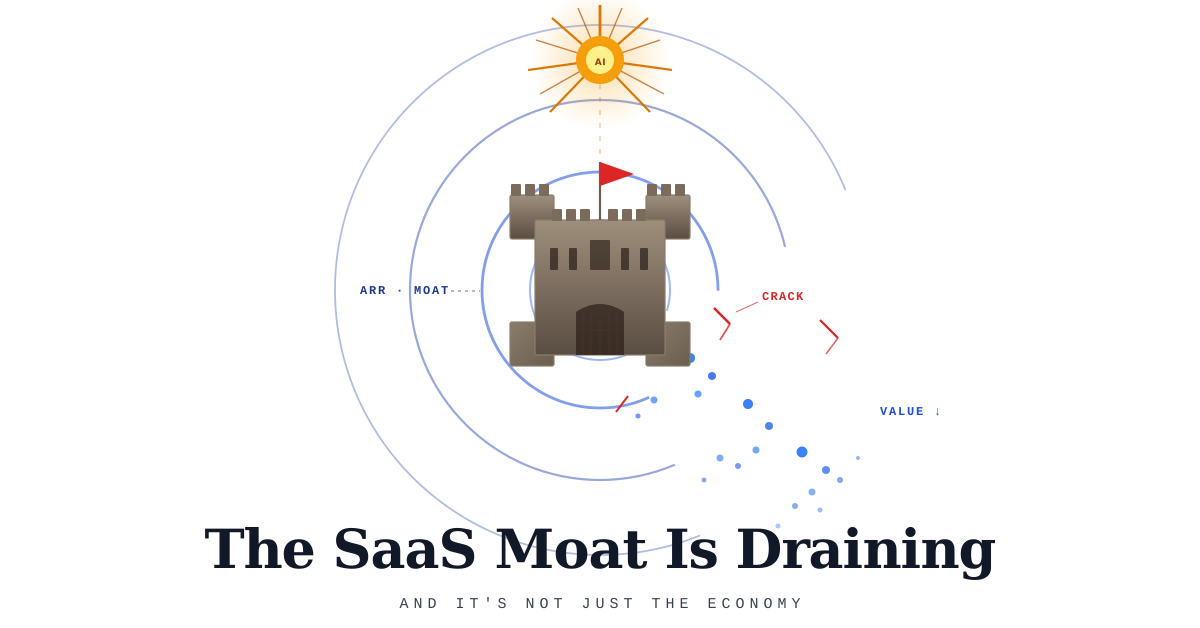
When implementation gets cheap, the moat that was built on implementation difficulty starts draining.
Why VCs Loved SaaS in the First Place
I want to be specific about this because I think it's the crux.
Before the current AI wave, SaaS was the ideal asset class for private markets. The unit economics were beautiful on paper: acquire a customer once, collect recurring revenue for years, expand them over time. Enterprise SaaS was even better — longer sales cycles, yes, but once you were in, you were in. The CTO who championed your tool isn't going to rip it out in year two and explain to the board why they're switching. Inertia is a feature, not a bug.
So VC money poured into SaaS because it was essentially parking capital in a relatively predictable machine. High growth, durable revenue, multiple expansion on the way to an IPO or acquisition. The model worked as long as two things held:
Software stayed hard to build
Switching costs stayed high
AI is attacking both of those simultaneously.
Software is getting cheaper to build — we've covered that. But the switching cost story is equally important and less talked about. If a competitor can build a functionally comparable product in a fraction of the time, and if that product can be tailored more specifically to your customer's workflow, the incumbent's stickiness advantage shrinks. The switching cost isn't zero — it never is — but it's no longer the wall it was.
And investors have noticed. KPMG described investors as far more intentional, with shallow "AI wrappings" losing favor to companies with genuinely defensible models[4]. Public SaaS multiples have compressed significantly from their 2021 peaks. Private market valuations follow, usually with a lag. MSCI observed that old-fund NAV was piling up as paper value rather than being recycled as spendable cash[1] — which tells you everything about how private market value is being quietly eroded without a loud headline moment.
The Staffing Model Is Changing Too
Here's the part that hits closest to home for me, because I've had to think about it as someone who has hired and managed software teams for years.
The old SaaS growth model was roughly: raise capital, hire aggressively, grow ARR, raise more capital, repeat. Headcount was the output metric. If ARR went up 40%, you expected headcount to go up proportionally. That's just how it worked.
That logic is breaking.
High Alpha's 2025 SaaS benchmarks found that over one-fourth of SaaS companies had already reduced headcount in engineering, customer success, and marketing because of AI[10]. Not because the business was struggling. Because they genuinely believed they could do more with fewer people. B2B SaaS companies are now generating 40% of new ARR from existing customers — up from 25% in 2022[11]. The growth engine is shifting from acquisition to retention and expansion, which is a much more efficient, less headcount-intensive motion.
Carta's H1 2025 compensation report reinforced this[9]: since the start of 2023, monthly net headcount at startups has hovered close to zero after years of rapid expansion. That's a structurally different hiring regime, not a temporary slowdown.
Put it together: tighter capital, AI-enabled efficiency, and a growth model that's less dependent on headcount growth. That is a permanently smaller hiring market for most SaaS companies, independent of the funding cycle.
I want to be honest about what this means for engineers. The roles most exposed are the ones that are most purely implementation-focused in domains where the implementation has become commoditized. If you're doing undifferentiated work at a mid-tier SaaS company without a defensible moat, that's a precarious place to be.
The roles that are less exposed — and I'd argue expanding — are the ones that require genuine systems thinking, security depth, infrastructure, AI-native product work, and the kind of judgment you only get from having built and broken things in production for years. CompTIA's April 2025 data showed AI-related positions accounting for 21% of active tech job postings[13], with software developers and engineers still among the most in-demand roles overall. The BLS projects 15% growth for software developers from 2024 to 2034[14] — roughly 129,200 openings per year. Those roles are shifting, not disappearing.
So Where Does This Leave Us?
I've seen a few cycles now. I've watched the dot-com implosion. I was building when mobile exploded. I was there when cloud ate on-premise. Each time, the industry reorganized, jobs moved, skills became obsolete, new ones became valuable.
This is one of those reorganizations. But it's faster than the previous ones, and the mechanism is different.
The liquidity drought and the VC concentration story are real, and they're making the near-term funding environment genuinely difficult for most founders. The top 10 funds raised 42.9% of committed capital in Q3 2025 while emerging-manager fundraising fell to its lowest level since 2015[3]. That's not a market that's evenly hard. It's a market that's stratified.
The exit window is reopening, but selectively. EY reported global IPO activity rose 19% year over year in Q3 2025 in volume and 89% in proceeds — but with investors scrutinizing fundamentals and profitability pathways far more carefully[8]. Crunchbase found 13 U.S. venture-backed unicorns had gone public by mid-August 2025, up from eight in all of 2024, collectively worth $86 billion[7]. That doesn't describe an ecosystem dying. It describes one reopening only for the stronger names.
The deeper thing — AI making software cheaper to build, SaaS moats narrowing, valuations compressing, private markets being repriced — that doesn't reverse when liquidity improves.
SaaS isn't dying. The companies with genuine defensibility, real network effects, deep vertical integration, or hard technical problems at their core are going to be fine. But the companies that were living on ARR predictability and switching costs alone? That moat is thinner than it used to be, and getting thinner. And the job market those companies used to generate — the endless wave of generalist SaaS engineering roles, the growth-at-all-costs headcount — that's not coming back the way it was.
I've never been pessimistic about this industry. I'm not pessimistic now. But I am clear-eyed.
The engineers who are going to do well are the ones who understand this is a different game now — and play accordingly.
References
- ↩MSCI — Private Capital in Focus: Depressed Distributions, No End in Sight (May 2025)
- ↩Juniper Square — The State of Venture Capital: Q2 2025 (PitchBook-NVCA Venture Monitor)
- ↩Juniper Square — The State of VC: Q3 2025 (PitchBook-NVCA Venture Monitor)
- ↩KPMG — United States: Q4'25 Venture Pulse Report
- ↩KPMG — Q4'25 Venture Pulse Report: Global Trends
- ↩Crunchbase News — Global Venture Funding In 2025 Surged As Startup Deals And Valuations Set All-Time Records
- ↩Crunchbase News — Bigger Outcomes As Startup Exits Gain Steam In 2025
- ↩EY — Global IPO Market Surges Amid Rising Investor Confidence in Q3 2025
- ↩Carta — State of Startup Compensation: H1 2025
- ↩High Alpha — 2025 SaaS Benchmarks Report
- ↩Maxio / Benchmarkit — What Are the Latest SaaS Metrics Benchmarks Telling Us?
- ↩CompTIA — State of the Tech Workforce 2025
- ↩CompTIA — April 2025 Tech Jobs Hiring Activity Update
- ↩U.S. Bureau of Labor Statistics — Software Developers, QA Analysts, and Testers: Occupational Outlook Handbook
Loading comments...