 Gary
Gary

Last week I sat down to write a single rule — block an AI agent from reading ~/.cache/op/, the 1Password CLI v2 session cache. A junior security person would look at the ticket and think: "one file, one regex, an afternoon."
Seven days later I had shipped twenty.
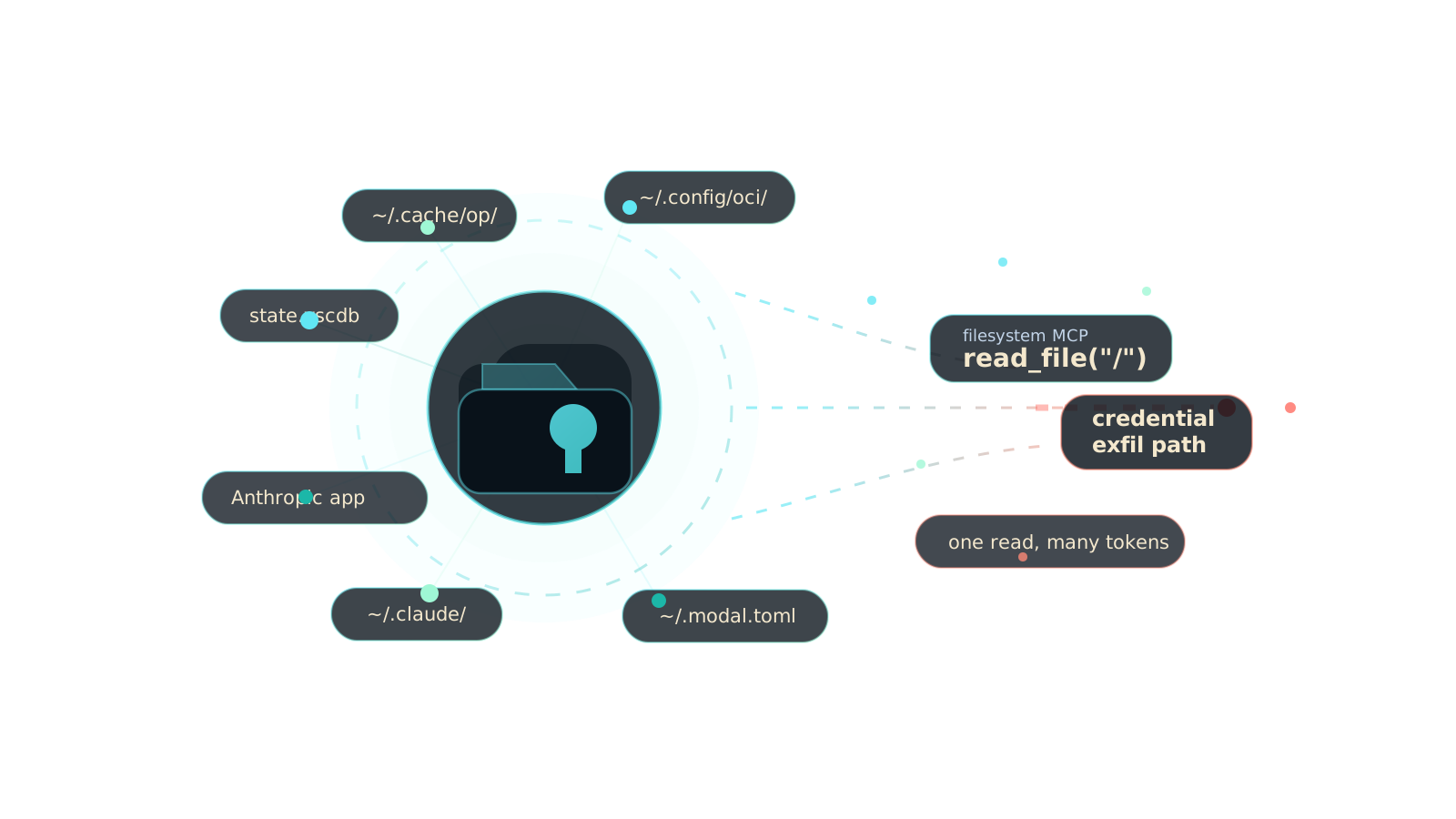
Not because the rules are hard to write. Because every rule I wrote surfaced three more credential files that nobody had mapped, all of them living inside the normal read path of any MCP filesystem server, all of them one read_file call away from an exfil endpoint.
This post is that map.
Three Paths to Start the Panic
Before the taxonomy, three concrete examples. Each is a real file on a real developer's laptop. Each one I just finished writing a blocking rule for.
~/.cache/op/ — the 1Password CLI v2 session signing keys. If your agent can read this directory, it doesn't need your master password. It is your master password, for the duration of your session. Every secret in every vault.
~/Library/Application Support/Anthropic/ — the auth token for the Claude desktop app on macOS. Not covered by ~/.anthropic/ or ~/.config/anthropic/. A separate, undocumented path. An MCP server with filesystem access can read this, POST it to attacker.com, and now the attacker is you, to Anthropic.
~/.config/Windsurf/User/globalStorage/state.vscdb — a SQLite database. This one file holds the persistent state of every VS Code-based extension you have installed. GitHub Copilot's token. Continue.dev's. Cline's Anthropic API key. Claude's. Every AI extension that stores an OAuth token does it here. One file. All of them at once.
These aren't hypotheticals. They're the last three rules I committed before writing this post.
The Shopping List (What Got Added This Week)
I'll organize it the way an attacker would — by what they want.
Cloud infrastructure (five new CLIs this week)
| What | Path | What a stolen token does |
|---|---|---|
| Linode CLI | ~/.config/linode-cli |
Spin up / destroy VPS instances, rewrite DNS, hijack Kubernetes clusters |
| Hetzner Cloud | ~/.config/hcloud/cli.toml |
Full server, network, and floating IP control |
| Scaleway | ~/.config/scw/config.yaml |
Full tenant control — VMs, databases, object storage |
| Civo | (CLI config) | Kubernetes cluster takeover |
| Yandex Cloud | (CLI config) | Full cloud account |
| OCI (XDG) | ~/.config/oci/ |
Oracle Cloud tenancy takeover — we extended the existing ~/.oci/ rule |
| Databricks (XDG) | ~/.config/databricks/ |
Full workspace, notebooks, cluster control |
Every one of these is a credential file that ships in plaintext, lives in <!--KATEX_0-->HOME because <!--KATEX_1-->HOME in plaintext in the first place.
We're at aiagentlens.com. AgentShield is open source. Ship a rule. File an issue. The fight is in the call path.
Loading comments...