 Anshuman Biswas
I want to tell you about a bug that started with a simple Cloudflare error and ended with me staring at post-quantum cryptography specs at 2 AM, wondering what year it is.
It began innocently enough:
Cloudflare Error 525 – SSL Handshake Failed
Okay, fine. SSL errors happen. But here's what made this one weird — I had four other domains on the exact same VM, behind the same nginx, the same firewall, the same Cloudflare account. All of them worked perfectly.
Just this one domain refused to cooperate. And that's when I knew this was going to be one of those debugging sessions.
Checking the Obvious Stuff First
Error 525 usually comes down to something boring: origin not listening on 443, bad cert, expired cert, wrong Cloudflare SSL mode, firewall getting in the way. So I ran through the checklist.
Cert and key — do they actually match?
sudo openssl rsa -noout -modulus -in /etc/nginx/ssl/xyz.com.key | openssl md5
sudo openssl x509 -noout -modulus -in /etc/nginx/ssl/xyz.com.crt | openssl md5
Hashes matched. Good.
Can I handshake directly, bypassing Cloudflare?
openssl s_client -connect <origin-ip>:443 -servername xyz.com
Worked fine. TLS 1.3 negotiated, certificate looked correct, everything clean.
Cloudflare was set to Full (Strict). SANs covered both *.xyz.com and xyz.com.
Everything checked out. And yet — 525.
Going Deeper: "Maybe It's Networking?"
At this point I started grasping at straws. Maybe Cloudflare was hitting the wrong IP? Maybe there was some IPv6 weirdness? Firewall rules I'd overlooked?
None of that panned out. But when I pulled up a packet capture, something caught my eye.
Cloudflare was connecting. The TLS handshake did start. But then the server sent back a fatal alert and killed the connection.
Now I was paying attention.
What the Packets Actually Showed
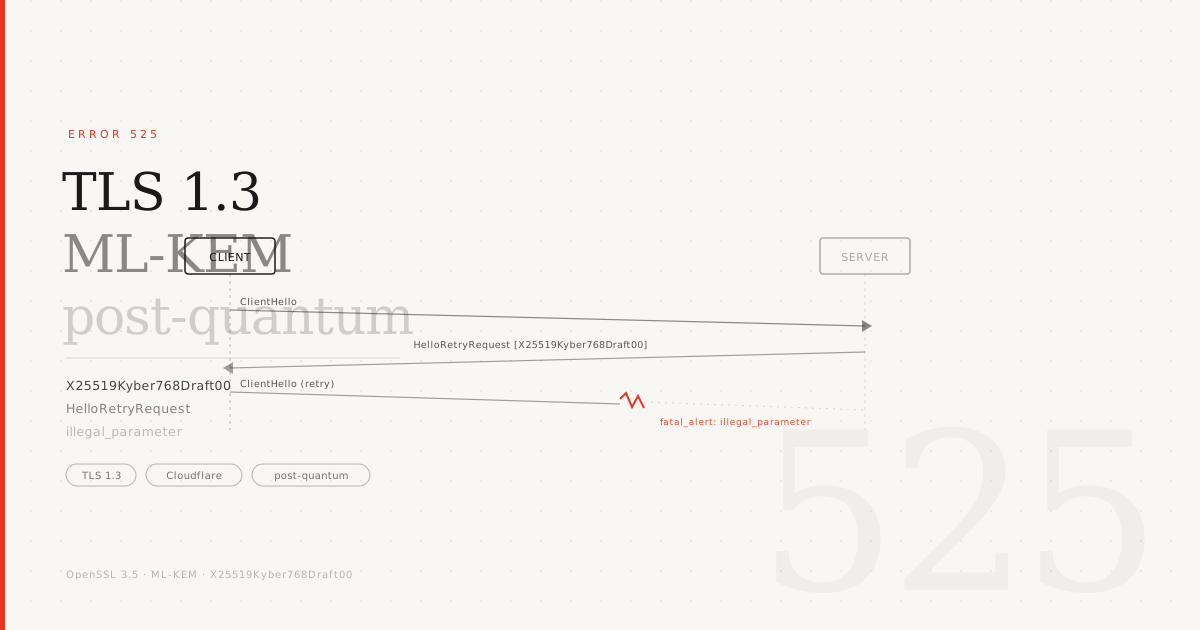
Here's how the handshake played out:
Cloudflare sends a
ClientHelloServer responds with
HelloRetryRequestServer asks for a specific key exchange group: X25519Kyber768Draft00
Cloudflare retries with that group
Server responds with:
fatal alert: illegal_parameterCloudflare shows us: 525 – SSL Handshake Failed
And just like that, we're deep in TLS internals.
The Actual Root Cause
My server was running OpenSSL 3.5.3. This version supports post-quantum key exchange — specifically the finalized ML-KEM standard, which uses X25519MLKEM768.
But Cloudflare's edge servers still offer the draft Kyber version: X25519Kyber768Draft00 (group ID 0x11ec).
Here's what was happening under the hood:
Cloudflare offers both draft Kyber and finalized ML-KEM in its ClientHello
OpenSSL incorrectly selects the draft Kyber group and sends a HelloRetryRequest for it
Cloudflare obliges and retries with the draft key share
OpenSSL can't actually process it — draft format and finalized format aren't compatible
Server sends
illegal_parameterCloudflare translates this into a 525
So this had nothing to do with certificates. Nothing to do with the firewall. Nothing to do with nginx config.
It was a post-quantum TLS interoperability mismatch. Bleeding-edge crypto meeting production reality.
Why My Manual Tests Never Caught It
This is what made the bug so sneaky. When I tested with openssl s_client, the handshake negotiated standard TLS 1.3 with classical ECDHE key exchange. No post-quantum groups involved.
But Cloudflare's edge aggressively negotiates hybrid post-quantum groups. Different client, different handshake path, completely different outcome. My test tool wasn't exercising the same code path that was actually breaking.
The Fix
I didn't downgrade TLS. Didn't disable TLS 1.3. Didn't weaken anything.
I just told nginx to stick with classical ECDHE curves:
ssl_ecdh_curve X25519:prime256v1:secp384r1:secp521r1;
I added this globally in /etc/nginx/nginx.conf and also in the specific server block, just to be safe.
Quick reload:
sudo nginx -t
sudo systemctl reload nginx
525 gone. Instantly.
This works because it prevents OpenSSL from even attempting the post-quantum hybrid groups, which avoids the broken HelloRetryRequest loop entirely. TLS 1.3 stays on, modern cipher suites stay on, security posture stays strong. We just surgically removed the one incompatible negotiation path.
What I Took Away From This
525 doesn't always mean "your SSL is broken." Sometimes the handshake itself is fine — it's the negotiation that fails, in ways that are invisible unless you're looking at packets.
Modern TLS clients don't all behave the same. Your openssl s_client test and Cloudflare's actual edge servers can take completely different paths through the handshake.
Post-quantum crypto is here, and so are the growing pains. Draft standards and finalized standards don't always play nice together, and you might be running both without realizing it.
When everything "looks correct," go lower. Packet captures were the only thing that cracked this one open.
And honestly — running bleeding-edge crypto in production is pretty exciting. Right up until it isn't.
If You're Hitting This Too
This wasn't a misconfiguration or a mistake on anyone's part. It's just a transitional moment in TLS. Cloudflare is moving toward post-quantum. OpenSSL finalized ML-KEM. The draft and final formats aren't compatible. And that tiny gap produces a deeply unhelpful error message:
SSL Handshake Failed (525)
If you're running OpenSSL 3.5+ and suddenly seeing mysterious 525 errors behind Cloudflare, check your TLS key exchange groups.
You probably don't have an SSL problem. You might have a post-quantum problem.
Loading comments...